
Best Time to Visit South America: Wildlife and Adventure
South America is the trip I most consistently undersell when clients first ask about it. I tell them it is complicated, that the distances are real, that the altitude will surprise them somewhere they did not expect, and that the logistics require more pre-planning than almost anywhere else I book. Then I watch them come back from two weeks in Peru and Ecuador looking like they finished the best trip of their lives. The complication is the point. South America does not reward improvisation, and the travelers who prepare for it properly get a version of the continent that most tourists simply never reach.
The region spans more climate zones, ecosystems, and cultural traditions than most people account for when they start planning. Peru alone contains coastline, high Andean valleys, cloud forest, and Amazon basin within a few hours of driving. Ecuador adds the Galapagos Islands and one of the most intact indigenous market cultures in the hemisphere. Argentina anchors the southern end with a city that competes with any capital in Europe for food, architecture, and evening culture. Getting the sequencing right is what separates a scattered South America trip from a focused one.
What the Best Time to Visit South America Actually Means
The best time to visit South America depends entirely on which part of the continent you are targeting, and trying to optimize for the whole thing at once is the planning mistake I see most often. The Inca Trail closes every February for maintenance and cleaning. Patagonia is genuinely hostile from May through September and genuinely spectacular from November through March. The Peruvian Amazon has a dry season that concentrates wildlife along river banks in ways the wet season does not. The Galapagos is accessible year-round but the wildlife calendar shifts significantly by month.
For a Peru and Ecuador combination, the May through October window consistently produces the clearest skies over Machu Picchu, the most reliable trekking conditions in the Sacred Valley, and the driest version of Quito and the Andean highlands. Travelers who want to include the Galapagos can anchor there at almost any point in the itinerary, though June through December tends to produce the clearest water for diving and snorkeling. The honest answer to the best time to visit South America question is that there is no single correct window, but there is usually a correct window for the specific trip you are trying to build.
Peru and the Peruvian Wildlife Question
Peruvian wildlife is one of the most underestimated draws on the continent. Travelers focus on Machu Picchu, on the Sacred Valley, on the food scene in Lima, and on the Inca Trail, and many of them do not realize until they are in-country that Peru sits on top of some of the most layered wildlife habitat in the world. The cloud forests above Cusco shelter spectacled bears and more than 800 species of birds. The amazon rainforest in Peru hosts jaguars, pink river dolphins, giant river otters, and clay lick formations where dozens of species gather at dawn to consume mineral-rich soil.
The best access to the Peruvian Amazon runs through Puerto Maldonado in the south or Iquitos in the north. Puerto Maldonado connects to the Tambopata Research Center and the Manu national reserve and Biosphere Reserve, both national parks and protected areas that offer multi-day stays inside wilderness with serious naturalist guides. The wildlife of peru found inside these reserves is the reason serious nature travelers build entire itineraries around this region. Iquitos sits deeper in the basin and is accessible only by river or air, which limits the crowds and amplifies the experience. Travelers who come expecting a day trip and leave after three days consistently say the Peruvian Amazon was the section of the trip they did not know they needed.
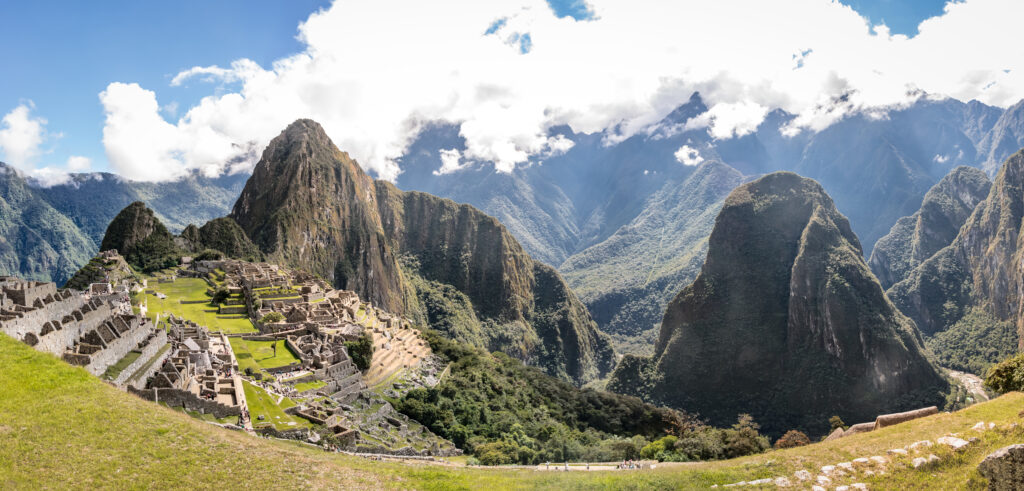
Machu Picchu sits at roughly 7,970 feet, which surprises most travelers who arrive from sea level. The high altitude at the site is manageable for most people with a day of acclimatization in Cusco first, but skipping that acclimatization day is the single most common mistake I see on self-booked Peru itineraries. Cusco itself sits at 11,200 feet. Arriving in Cusco and heading directly to the ruins the next morning is a reliable way to spend your best travel day feeling terrible. Build in the altitude buffer and the whole Cusco to Machu Picchu circuit becomes the highlight it is supposed to be. The national reserve areas around the Sacred Valley add birding and trekking options that most travelers never reach on a standard itinerary.
The Otavalo Market Ecuador Experience
The otavalo market ecuador produces is one of the most consistently moving travel experiences I have watched clients have in this hemisphere. The Saturday market in Otavalo is the largest indigenous craft market in South America and has been running continuously for centuries. Otavalan weavers have sold their textiles in this plaza longer than most countries in the hemisphere have existed. The quality of work on display, the continuity of the tradition, and the complete lack of the performance that typically comes with tourist-facing markets in other destinations make it feel like an actual working cultural institution rather than an attraction.
Otavalo sits about two hours north of Quito in the Andean highlands, and pairing it with a night in the area gives travelers access to the early morning animal market and the main textile plaza before the day-trippers from Quito arrive. The town of Cotacachi, a short drive from Otavalo, specializes in leather goods and offers a quieter version of the same craftsmanship. Combining the two markets with a stop at Cuicocha crater lake rounds out a genuinely full day in the highlands that most travelers rank among their best in Ecuador.
Lake Titicaca and the High Altitude Circuit
Lake Titicaca sits at 12,507 feet on the Peruvian-Bolivian border and is the highest navigable lake in the world. The floating reed islands of the Uros people, the island communities of Amantani and Taquile, and the deep blue of the lake against the high altitude sky combine to produce views that look like a photographer staged them and are actually just what the place looks like every morning. Travelers who have been to the Maldives or the Seychelles often describe Titicaca as equally surreal in a completely different register.
The circuit from Cusco through the Sacred Valley, Machu Picchu, Puno, and Lake Titicaca makes a coherent southern Peru loop that most travelers can cover in eight to ten days. Adding a crossing into Bolivia and a few days in the salt flats of Uyuni extends the loop into one of the most visually distinctive travel weeks available anywhere. The high altitude at every stop on this circuit means the acclimatization question stays relevant throughout, and the right pace through the loop makes all the difference between a trip that feels effortful and one that feels exhilarating.
Buenos Aires as a Southern Anchor
Buenos Aires earns its own visit separately from the rest of the continent. It is the city I most consistently recommend to travelers who have done a lot of international travel and want somewhere that rewards knowing how to move through a city. The food scene, centered on the parrilla tradition and driven by serious wine culture from Mendoza and the Malbec regions, is world class in a way that rarely gets the international attention it deserves. The architecture in the Palermo and Recoleta neighborhoods is genuinely beautiful, and the city’s energy runs late in a way that suits travelers who like their evenings to have a second act.
Buenos Aires works well as a starting point for a Patagonia extension to Torres del Paine or El Calafate, and it works equally well as a standalone city trip. Travelers who combine two days in Buenos Aires with a wine country overnight in Mendoza come back with a version of Argentina that the resort travelers who stay in one place never see. The combination is easy to arrange and consistently produces some of the best food and wine memories of any trip I build.
Building the Trip
South America rewards travelers who think in regions rather than countries. A Peru plus Ecuador combination covers Machu Picchu, the Galapagos, the amazon rainforest, and the highland markets in a coherent two-week arc. A Peru plus Argentina combination covers the Sacred Valley, Lake Titicaca, Buenos Aires, and Patagonia in a longer three-week version. Both trips require a serious operator inside Peru for the wildlife and trekking days, and both trips improve significantly when the routing accounts for altitude acclimatization rather than treating it as an inconvenience.
Conclusion
South America is the region I have watched change the most travelers over the years. The destinations that reward preparation and specialized guidance are the ones that tend to produce those results, and South America delivers them consistently for travelers who come in with a realistic plan and a guide who knows the terrain. The continent will ask more of you than a beach resort. It will also give back more than almost anywhere else I have ever sent a client.
Peru’s official tourism site covers regional entry requirements, recommended itineraries by season, and guides to the wildlife reserves that make the country one of the top nature destinations in South America.
For more on high-contrast destinations that reward careful timing, read our guide to where Asia and Latin flavor meet.