
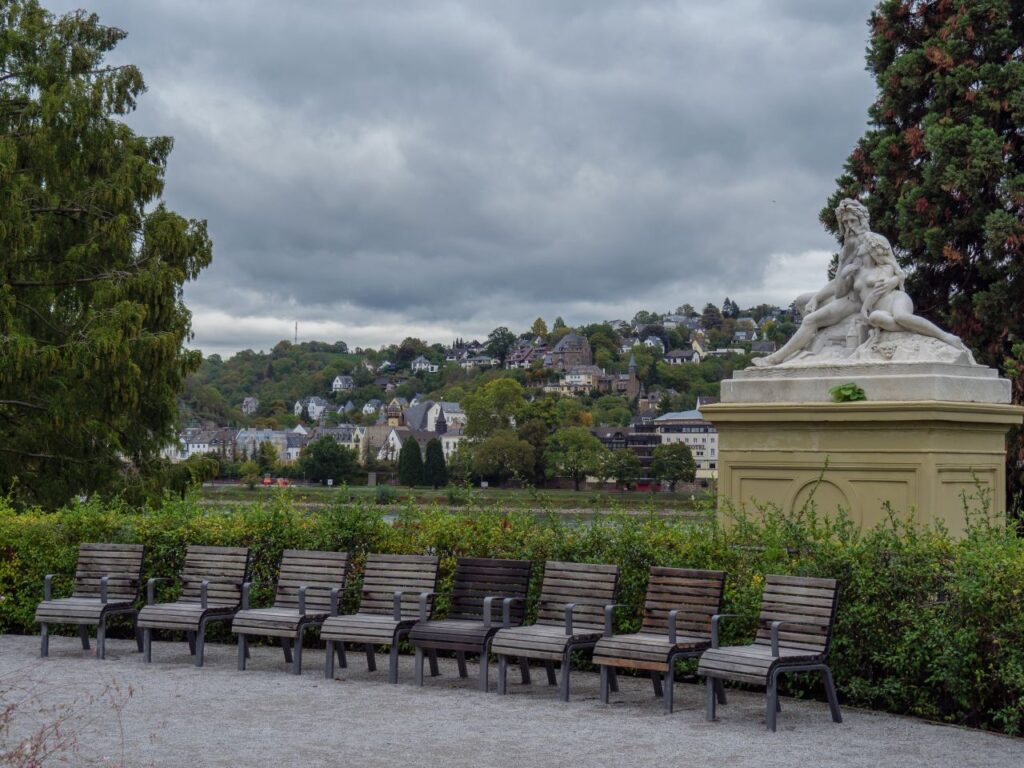
Three Rhine Towns Worth Knowing
Travelers arriving in Koblenz often feel an instant sense of excitement. The city sits at one of the most dramatic points on the entire Rhine, where the Moselle joins the main river at a promontory that the Romans identified as the ideal location for a fort two thousand years ago. But Koblenz is one of three towns along this section of the Rhine that reward extended attention: Konigswinter to the north, with its hilltop castle and dragon legends, and Oestrich-Winkel in the heart of the Rheingau wine country, each add different dimensions to what a cruise through this valley can contain.
These three towns represent the range the Rhine offers at its most concentrated. Together they span military history, German mythology, Gothic architecture, and some of the finest wine produced in the country. Any itinerary that gives them proper time returns travelers to the ship with a more layered understanding of the valley than the scenery alone provides.
Koblenz: The Confluence City
The Deutsches Eck, the pointed headland where the Moselle meets the Rhine, is Koblenz’s most distinctive geographic feature and one of the most photographed spots on the river. The equestrian statue of Kaiser Wilhelm I that stands at its tip gives the confluence a monumental quality that makes the view from the opposite bank even more striking. From Ehrenbreitstein fortress across the river, accessible by cable car, the full geometry of the confluence becomes visible, along with a view that extends up both valleys simultaneously.
The city’s historic center is organized around several exceptional landmarks. The Basilica of St Castor, dating from the 12th century, is among the most important Romanesque churches in the Rhineland. Jesuitenplatz is a lively square surrounded by Baroque facades that gives the city its most characteristic streetscape. Stolzenfels Castle on the southern approach to the city is a 19th century Gothic Revival reconstruction built for the Prussian royal family, its ornate interiors and terraced gardens offering one of the more complete examples of Romantic-era Rhine castle fantasy.
Konigswinter and the Dragon’s Rock
Konigswinter sits at the foot of the Siebengebirge, the range of volcanic hills that marks the northern boundary of the Middle Rhine Gorge. Drachenfels, the Dragon’s Rock, rises above the town with the ruined keep of a 12th century castle on its summit and the neo-Gothic Schloss Drachenburg on the hillside below. The rack railway that climbs to the summit was the first of its kind in Germany when it opened in 1883, and the combination of the ride, the view, and the ruins at the top makes for a morning that delivers at every stage.
The Nibelungenhalle near the base of the mountain celebrates the legendary associations of the site, with murals depicting scenes from the Nibelung saga that connected Siegfried’s dragon-slaying to this particular hill. For travelers interested in how the Rhine Romantics of the 19th century transformed the valley’s folklore into a defining national mythology, the combination of Drachenfels and the Nibelungenhalle is a concentrated version of that story. The Rheinsteig hiking trail runs through the Siebengebirge and extends the experience for guests who want more time in the hills above the river.
Oestrich-Winkel and the Rheingau Wine Country
Oestrich-Winkel sits in the Rheingau, the section of the Rhine where the river runs east-west and the south-facing slopes above the northern bank receive maximum sun. This geography produces conditions that have made the Rheingau one of Germany’s most celebrated wine regions for centuries, with Riesling grown on steep terraced vineyards above towns whose names appear on wine labels around the world. Oestrich-Winkel itself encompasses several formerly separate villages, each with its own estate traditions and cellar character.
The Niederwald Monument stands on the ridge above the vineyards, its allegorical figure of Germania looking out over the river toward Bingen. The monument was built after the Franco-Prussian War to celebrate German unification, and its scale and hilltop position give it a presence that can be seen from far along the river in both directions. Eltville, close by, has an intact medieval castle tower and rose gardens that make the town worth a short detour, and the Rheingau Christmas market is among the most atmospheric in the region when the season arrives.
Planning Your Rhine Towns Itinerary
The three towns span enough of the Middle Rhine to suit different sailing directions and durations. Koblenz is a common starting or ending point for Rhine cruises and justifies at least half a day. Konigswinter rewards a morning that includes the Drachenfels ascent. Oestrich-Winkel and the Rheingau work best in autumn harvest season, when the vineyards are active and the estate tastings are surrounded by the physical context of the vintage in progress.
A Latitude 21 travel specialist can structure a Rhine itinerary with Avalon Waterways or AMA Waterways that gives each of these towns the time its specific character requires. The Rhine’s top towns are well known, but experiencing them well rather than simply visiting them is a matter of planning, pacing, and knowing what each place actually contains.
The UNESCO Upper Middle Rhine Valley listing covers the stretch of river that most Rhine cruise itineraries treat as their scenic centerpiece.